Age of Forgiveness, Caleb Curtiss
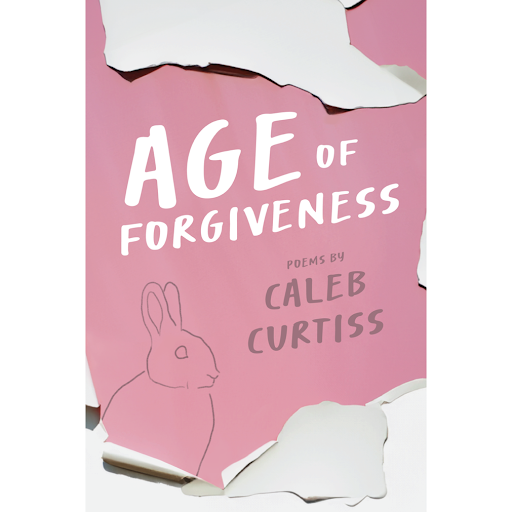
Caleb Curtiss’s debut full-length collection faces the sudden death of his sister as he recounts the traumatic childhood they shared together. In 33 lyrically charged poems and five visual erasures, Age of Forgiveness documents a familial apocalypse from its onset to its aftermath. A God too busy to return Noah’s frantic calls, a vast, Eden-like lawn, and a rundown strip mall arcade all serve as backdrops for these poems, which do not deliver easy answers or serve as neat parables, but exist as documents that seek to shed light on what it means to recover.
“Emotionally precise and sonically rich, the poems of Age of Forgiveness go for the jugular—or seem to—and end up softly touching the tender. This beautifully lyric-narrative work never shies away from difficulty—in family, in religion, in the natural world, in the self. But engaging the difficult here is ultimately a way of moving toward the hopeful. And true hope, as this incisive poet understands, does not mean a sanitizing of the past but a compassionate examination of it: “the present tense / of your absence / tangible for a moment / and then not.” What a gift, these insights, these elegies and self-portraits and songs of trying again to love honestly and more fully.”
—Chen Chen, author of Your Emergency Contact Has Experienced an Emergency
“How close Caleb Curtiss brings us to danger in Age of Forgiveness: a sister’s death, her troubled marriage, winged creatures that come at night. In “Primer,” Curtiss reminds us that the most necessary part of a poem prepares us for what comes next, but readers will find themselves unprepared for his haunted, tender, and magically disorienting collection.”
—Janice N. Harrington, author of Primitive
“The poems in Age of Forgiveness by Caleb Curtiss possess a quiet courage. They are as solid, and magnificent, as a coastal shelf that collects the layers of the past, and the story those layers tell us about the future. These poems are anchors for when the ‘firmament trembles from time to time.’”
—Tomás Q. Morín, author of Machete
“If, to create an erasure, the poet carves everything away that is not the poem, then these poems might be the opposite of erasures. In Age of Forgiveness, absence is a presence, and Caleb Curtiss shows us the complicated whole: the ways we remember and the ways we resist remembering; the things that are funny but not. Grief, like time, pixilates, obscures, and makes strange—and Curtiss doesn’t resist that distortion (‘memory / looped like tape / in a cassette, / worn out / with play’) but instead makes it his medium. Not since Matt Rasmussen’s Black Aperture has a book of poems moved me like this.”
—Maggie Smith, author of Goldenrod