
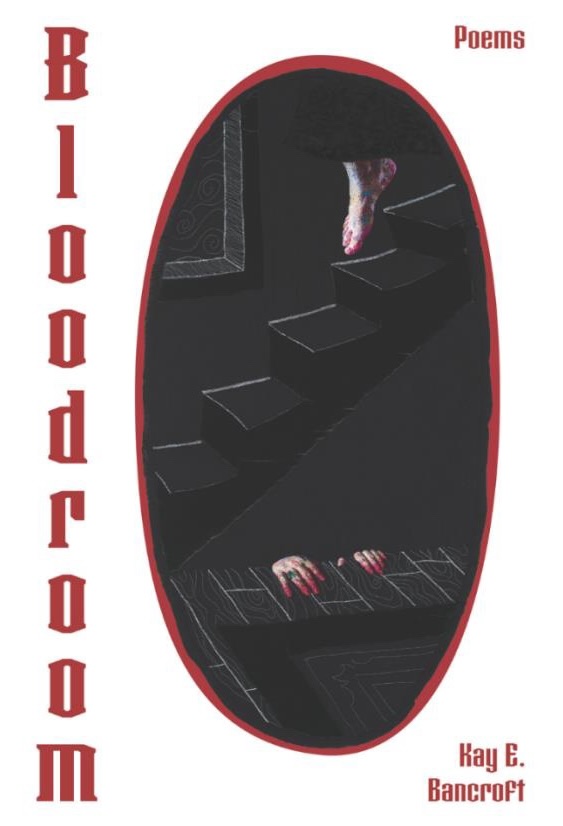
Bloodroom, Kay E. Bancroft
“Do you identify with any of the above terminology? Occasionally. Some days they feel appropriate. Others, I resent these tools of our language. I reject and embrace, synchronously.”
Bloodroom is a howling, scorching debut collection of deftly formatted poetry—circling, and delicately probing, themes of familial debt, legacy, obligation, and the matriline. Through an index of past wounds and inherited scars, the speaker bleeds their histories together with the slow erosion of nostalgia. These poems offer an incisive and scalding interrogation of gender, yet are often unbearably tender—a swirling emulsion of grief and anger poured into an intricately technical and beautifully challenging mold. Each piece draws out a tragic, cyclical song of love and loss, resentment and admiration, as though drawing poison from a wound. Bancroft’s writing is meditative, cleansing, and compulsively readable: recounting a feminine childhood transformed into something monstrous until seen through a new lens. Bloodroom is a plea to identity, to the process of searching for purpose and of seeking certainty in a broken world.
***
“Kay E. Bancroft makes me want to be brave—to be able to watch horror movies with my eyes open and to shake up language until only sincerity remains. Get ready to experience Bloodroom, a work that is part poetry collection, part museum exhibit, and part science experiment. You will walk away from this book a whole new creature.”
–Paige Lewis, author of Space Struck
*
“I was had here,” Kay Bancroft’s Bloodroom begins, both gifting the reader a “here” while ambivalently confining them to it. This is Bloodroom’s main obsession: how the speaker’s given narratives, identities, and sense of belonging are both gift and constituted by—intergenerational, imperial—theft. Across a series of photographs of the author’s face, a censor bar reads, “How can we prevent these past iniquities from burgeoning in our bodies?” The past is already burgeoning though. Like in one of the horror films Bancroft cites, It Follows, the horror is found less in shadowy jumpscares than the slow-walk of creatures in the plain light of day. Bloodroom too is a measured horror, inheritance clambering along the speaker’s histories as “it passes from [one] wound to the next.” Knowledge and self-will alone are not enough to break the proverbial cycle; rather, Bloodroom confronts us with a more difficult truth—to “reject and embrace, synchronously,” reallocating the inheritance while fleeing its always-pursuant logic. The cycle is not “out there” but the call coming from inside the house. Or, the cycle is the house, is the self: “I must be the one to break.”
–Jos Charles, author of a Year & other poems
*
“In Kay E. Bancroft’s gorgeous debut, the definition of ‘daughter’ expands to include the unspoken debts a daughter inherits, the small print in the contracts thrust upon us upon birth. Bloodroom includes legal documents, photographs, fingerprints, and becomes a clinical record of abandonment, of how a matrilineal bloodline can bequeath ‘something that belongs to an inherited lot : // of suffering’ to its heirs. These are poems of deep longing—a longing for acceptance (from mothers, from the self, of mothers, of the self). These are also poems of a deep wisdom, poems that know “escape” from our complicated histories actually requires us to turn inward. Which is why ‘HELL IS REAL when my hands check my body for what’s in the dark.’”
–Dr. Taylor Byas, PhD, author of Resting Bitch Face
*
“Kay Bancroft’s deft debut Bloodroom is brim with glimmering sorrows: estrangement from a m____r, grief for a dead grandm____r, and traumas passed through matrilineal lines. This book teems with invention, weaving lyric in and out of forms archival, visual, redactive, and playful. When I say playful, I mean this is dead serious, play to keep alive, to keep from falling apart—I’m thinking of the poetics of Anthony Cody, Victoria Chang, and Douglas Kearney’s Patter, which deploys inventive and found forms to navigate difficult personal history. I’m stunned by Bancroft’s simultaneous strength and vulnerability; these poems “reject and embrace, synchronously,” exist in the safer but painful space of having wrested free from familial cycles of harm. No more passing of wounds from parent to child to their child, and so on. Of wounds, Bancroft writes they are ‘rough edged, / porous, and pulsing.’ This is how it feels to also be gendered: ‘Something struck through / me against my will, something I am forced to feel around.’ How remarkable to witness and feel along with them.”
–Diana Khoi Nguyen, author of Root Fractures
*
“’I was born here. It was constructed before me. I came after in clear, acrylic linen’ announces Kay E. Bancroft’s Bloodroom. And inside of that fire I hear the iconic question: What do we inherit and what of that inheritance can we refuse? Through a cornucopia of canonical and invented forms alike, the speaker attentively tells the story of their becoming, unbecoming, and refusal of the detonations in the bloodline. In Bloodroom, the studied pressure is dual: external and internal, societal and ancestral. The call is coming from inside the house and the speaker is unafraid to burn the whole lot down rather than repeat a forebear’s harm.
“I resent these / tools of our language. I reject and embrace, synchronously.” Yes, inside this book there is a way out, a way through. Inside this book there is a code decipherable by its own taught map. In poems like ‘Instructions,’ ‘breastbone’ and the ‘lexicon’ series, the book takes a posture both edifying and necessarily opaque—a murkiness that goads both the speaker and reader into querying our own histories.
“This collection queers its present and secures a rightfully mysterious future by studying the patterns of the past. The gross industry of reflexive familial roles is liberated by Bancroft’s deft images and explorative line work. Though the forms expand and contract, the language at the heart of the book is pure, unadorned and direct. ‘This solitude is where history nestles.’ In Kay E. Bancroft, we have a bold new voice, finding their own perfect pitch to scream and sing.”
–Angel Nafis, author of BlackGirl Mansion