Still My Father’s Son, Nora Hikari
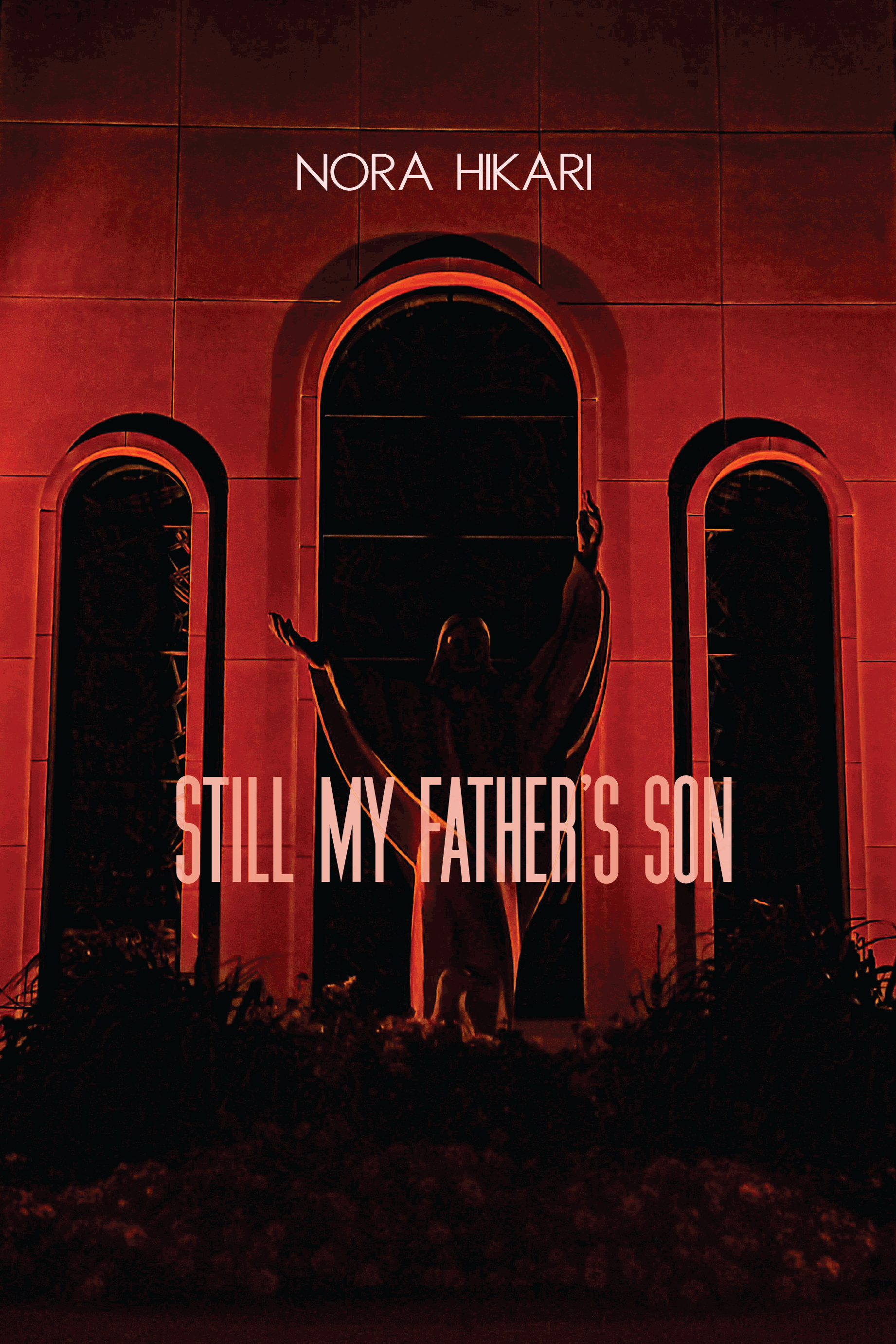
Still My Father’s Son by Nora Hikari weaves a complex & delicate tale of love, religious trauma, queerness, and self/selves. As we are systematically walked upstream through a shimmering river in which shrewd emotion and aching observations cascade, we bear witness to God & the lessons of his son, Uriel; to the speaker declaring that “Every person you have been deserves a burial and a headstone;” to the Vicious Self pleading to the Small Self, repeatedly through burning tears, that she is loved. A devastating intimacy surrounds this collection, omnipresent in moments where language is sharp enough to cut. Hikari’s work is an exploration into self-love at its most fractured and literal, and a beautiful homage to what it means to heal from/with/by deep-rooted pain. For, despite all the hurt in the world, “you can live. You can. You can live for all of the people we could be tomorrow, if you try.”
***
Existing somewhere in the space between an extended ars poetica, a discourse on cruelty and kindness, and a creation myth eating itself alive, Still My Father’s Son is an electrifying debut. Hikari is a poet of high lyric and bold proclamation, a combination that hones each line to a razor’s careful edge. The kind of poet who can render the sunrise a gash across the wrist of heaven and declare that “A sword is a sword / because it refuses / to be anything kinder” with the same startling candor.
–torrin a. greathouse, author of DEED (Wesleyan University Press, 2024)
Nora Hikari (Wires) writes that the words Mother & God both mean, “Something that could have saved you, but chose not to.” The poems in this book won’t save you either, but in the way that sharpness is not salvation’s sensation. In this collection poems are sharp like tools put to purpose. Blades gleam and glint, they divide and separate and taxonomize much as they do in the butcher’s hand carving flank from chuck. Poems that break themselves up and through and between forms and girl-voices and authenticities, and the sharpness is self-directed as much as it threatens the patriarch’s throat. This collection is cosmological, at times liturgical, at times the kinetic undoing of each. This collection is a chest of inheritance. In these poems, Hikari shows us the terrible, simple power of poetry itself: the power of naming and being named.
–Camellia-Berry Grass, author of Hall of Waters (The OS, 2019)
With writing both intimate and biblical in scale, STILL MY FATHER’S SON makes equal space for the love letter and the polemic. Uncompromising, ardent, and deeply trans, Nora Hikari’s debut serves as a creation myth with the poem as its prophet. “The poem ferries the girl into the future. She will survive this,” Hikari pledges. In her hands, the poem becomes something greater than poetry. The poem rarely sings like this. The poem rarely bleeds like this.
–Claire Heinzerling, poet and lead singer of screamo band The Names Of Our Friends