
Where My Umbilical Is Buried, Amanda Galvan Huynh
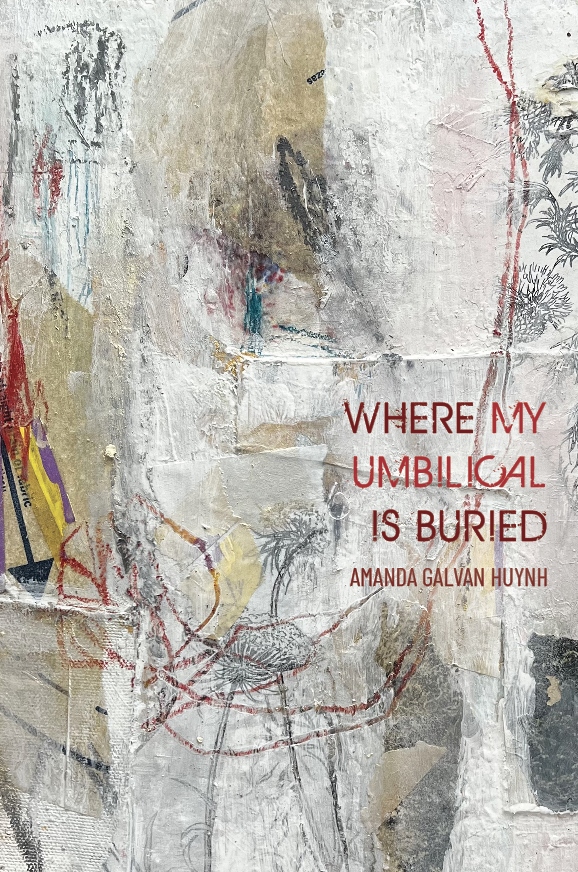
Amanda Galvan Huynh’s debut poetry collection Where My Umbilical is Buried is a “heart in purple” crayon under a table’s left rib. It remembers the laughter around a game of Lotería, “cicada shells / ghosting” tree branches, Texas-shaped tortillas, and learning “numbers in English, / in Spanish.” Here we find familial portraits scattered across small Texas towns, boots shuffling to La Reina de Cumbia in dance halls, hands “[grasping] at words” to make sense of an unforgiving world. Galvan Huynh asks us to consider the intersections of our heritage and to reflect on our mothering as it nests within our present selves. She calls us to witness the ramifications of assimilation and the inheritance of fear—how a tongue resists being “pulled away / saying grandpa instead of abuelo” and cultivates space to “envelop the Bidi Bidi Bom Bom [her] familia / sways to.” Where My Umbilical is Buried is a threshold for acceptance and healing. Galvan Huynh discovers what it means to be a daughter of a grieving mother, orphaned at sixteen, and the ways trauma passes down to the next generation. These poems meditate on what happens when a daughter has “no room left to hold / her mother’s pain.” We learn “to be worthy.” We learn “to dig / into the soil / and hold on.”
“From the title, Where My Umbilical Is Buried, Amanda Galvan Huynh invites readers to engage with the metaphor and image rich sensibility that drive the poems within. From the roads, nights, and fields where memory lies ‘buried’ under the sounds of voices whispering, Coke tab bracelets jangling, and cumbias, these poems grow and flourish into a lyric gift, an expression of affirmation and presence for gente y familia—the living, the dead, as well as who we must be in between.”
—José Angel Araguz, author of Rotura
“In her debut collection, Amanda Galvan Huynh cultivates poems that sing and ache toward the matriarchal, memory, and hope. In seeking to rupture intergenerational trauma, identity, and expectation, Galvan Huynh carves a complex and deft vision beyond knowing ‘how many seams kept them together,’ to achieve a conjuring that blesses ‘the hands of mothers who never had one to follow.’ Through rich imagery, vibrant meditation, and a resilient self-examination, Where My Umbilical is Buried weaves a code-switching tapestry that unabashedly confronts, complicates, and celebrates the lineages and experiences. These are intricate poems that manifest healing and dreaming for the self and future ancestors.”
—Anthony Cody, author of Borderland Apocrypha
“To read Amanda Galvan Huynh’s poetry is to remember the scent of my mother’s kitchen, the beat of cumbias and the trills of accordions, and the weight of family stories told in the language of pain and silence. In poems both fluid and powerful, Huynh demonstrates the hard-won struggle to become yourself—to own your language, culture, and sexuality when you’ve inherited more wounds than gifts from your mother and your mother’s mothers. Huynh writes, ‘Bless…The hands that may have/never planned on being/a mother and the ones/that feared being enough./Bless the hands of mothers/who never had one to follow,’ and in passages like this, Where My Umbilical is Buried becomes an act of learning to mother oneself, free oneself, love oneself. ¡Poeta brava!”
—ire’ne lara silva, author of Cuicacalli/House of Song
“Where My Umbilical is Buried offers a disarmingly precise series of poems about the intergenerational struggle to establish a sense of home when home offers its own turbulence. The reality of the working class Latinx families in America looms large over these poems. It haunts them, transfixes them, but in the process these poems create a deeply personal space where this struggle is transformed. In this collection there is a longing for home that goes past the social reality, past the domestic sphere, towards the celestial womb. There is a sense of longing on a cosmic scale, a yearning that stretches towards the stars. These poems heal, they flicker, they are a way of digging into the darkness and growing from the ground up.”
—Mike Soto, author of A Grave is Given Supper